Visiting a Māori Village in Rotorua: Which One Is Right for You?
Living, recreated or historic? Compare Whakarewarewa, Ōhinemutu, Te Pā Tū, Mitai, Te Puia and the Buried Village: prices, access rules, tikanga and which one suits you.
“Māori village” means very different things in Rotorua, and the difference costs money. The best choice for most visitors is Whakarewarewa, the one village where people live and where you can book an organised visit: a one-hour guided tour costs NZ$58 per adult from 1 October 2026. Pair it with a free, self-guided walk through Ōhinemutu, a living lakeside village. Te Pā Tū and Mitai are a different kind of place: evening venues built in the style of a village, where hosts welcome you, perform and feed you. Pick one of them if you want a show and a feast, but nobody lives there, so they aren’t somewhere to see everyday life.
Check Availability
Last checked 1 October 2026. Prices are in NZD unless marked US$, and operators change them, usually on 1 October. Check the official website before you book. rotoruamaorivillage.com is an independent guide; we are not owned by, or affiliated with, Whakarewarewa – The Living Māori Village or any other operator mentioned here. Some links earn us a commission at no extra cost to you, and that never affects our picks.
The short answer
If you want to see a Māori village where people live, go to Whakarewarewa on a guided tour (from NZ$58 adult), then walk through Ōhinemutu (free) on your own. If you’d rather have a welcome ceremony, a performance and a feast in the evening, book Te Pā Tū or Mitai; they are village-style venues, not homes. If you’re more interested in history and volcanoes, the Buried Village of Te Wairoa shows what was left of a Māori and European village after the eruption of 1886. And if what you want is Pōhutu Geyser up close, a kiwi and the national carving school, that is Te Puia, which is an institute, not a village.
Key facts at a glance
- Living villages you can visit: Whakarewarewa (guided entry only) and Ōhinemutu (free on public paths)
- Recreated / performance pā: Te Pā Tū (forest pā), Mitai (old pā site), Te Puia’s Pikirangi (replica)
- Working marae open to visitors through an operator: Rotowhio marae at Te Puia; the marae at Whakarewarewa (seen from outside on the tour)
- Historic, excavated village: Te Wairoa (the Buried Village), 15 minutes’ drive from Rotorua
- Overnight marae stays near Rotorua: very limited in 2026. Whakarewarewa’s is suspended.
- German speakers: “Maori Dorf Rotorua” usually means Whakarewarewa (das lebende Maori-Dorf). See the German note below.
What is a “Māori village”? Kāinga, pā, marae and urupā explained
- Kāinga is an ordinary village or settlement: homes, gardens, cooking places. Whakarewarewa and Ōhinemutu are kāinga.
- Pā traditionally meant a fortified village, often on a hill with palisades and terraces. Today people also use “pā” for a Māori settlement in general, especially one around a marae. Te Pā Tū puts it like this: pā “were places of physical refuge in times of war, and they remain sanctuaries for our mind and spirit.”
- Marae is the community’s ceremonial meeting ground. Te Ara explains that a marae “usually consists of a wharenui (meeting house) with marae ātea (courtyard) in front, a wharekai (dining hall) and an ablutions block.” The marae ātea is the open courtyard in front of the meeting house, where speeches are made during a welcome.
- Urupā is a burial ground. Urupā are tapu (sacred, restricted).
Four types of village you’ll come across in Rotorua
| Type | What it means | Rotorua examples |
|---|---|---|
| Living kāinga | A real community where people live today | Whakarewarewa, Ōhinemutu |
| Recreated / performance pā | Built or rebuilt for visitors to show traditional life | Te Pā Tū, Mitai, Pikirangi (Te Puia) |
| Working marae inside an attraction | A real ceremonial space that visitors see through a guided operator | Rotowhio (Te Puia) |
| Historic / excavated | A site whose people were killed or moved away; what remains is interpreted for visitors | Te Wairoa (Buried Village) |
Rotorua’s Māori villages compared
| Village | Type | Owner / community | Access | Price from (adult, NZD) | Time | Best for |
|---|---|---|---|---|---|---|
| Whakarewarewa – The Living Māori Village | Living thermal kāinga | Tūhourangi Ngāti Wāhiao residents | Guided only, 9am–3pm | $58 tour; $37 performance | 1–3 hrs | Real village life, thermal cooking, families |
| Ōhinemutu | Living lakeside kāinga | Ngāti Whakaue | Free, self-guided on public paths | Free; St Faith’s $5–7.50 | 45–90 min | Budget travellers, history, quiet reflection |
| Te Pā Tū | Recreated 1800s forest pā | Tauhara North No. 2 Trust | Ticketed evening, transport included | $280 | 3.5 hrs + transfers | Food lovers, couples, a special night out |
| Mitai Māori Village | Village-style venue on an old pā site | Mitai-Ngatai whānau | Ticketed evening or daytime | $179 evening; $105 day | 1.5–3 hrs | Hāngī, families, glow-worm stream |
| Te Puia (Rotowhio marae, Pikirangi) | Working marae and replica pā inside a cultural and geothermal park | NZ Māori Arts and Crafts Institute | Guided only | $105 (Te Rā) | 1.5–2 hrs | Carving and weaving, kiwi, Pōhutu Geyser close up |
| Buried Village of Te Wairoa | Historic excavated village plus museum | Smith family (four generations, not Māori-owned) | Self-guided, ticketed | $30 international; $25 NZ resident | 1–2 hrs | History buffs, volcano stories, waterfall walk |
The nine bookable options on GetYourGuide
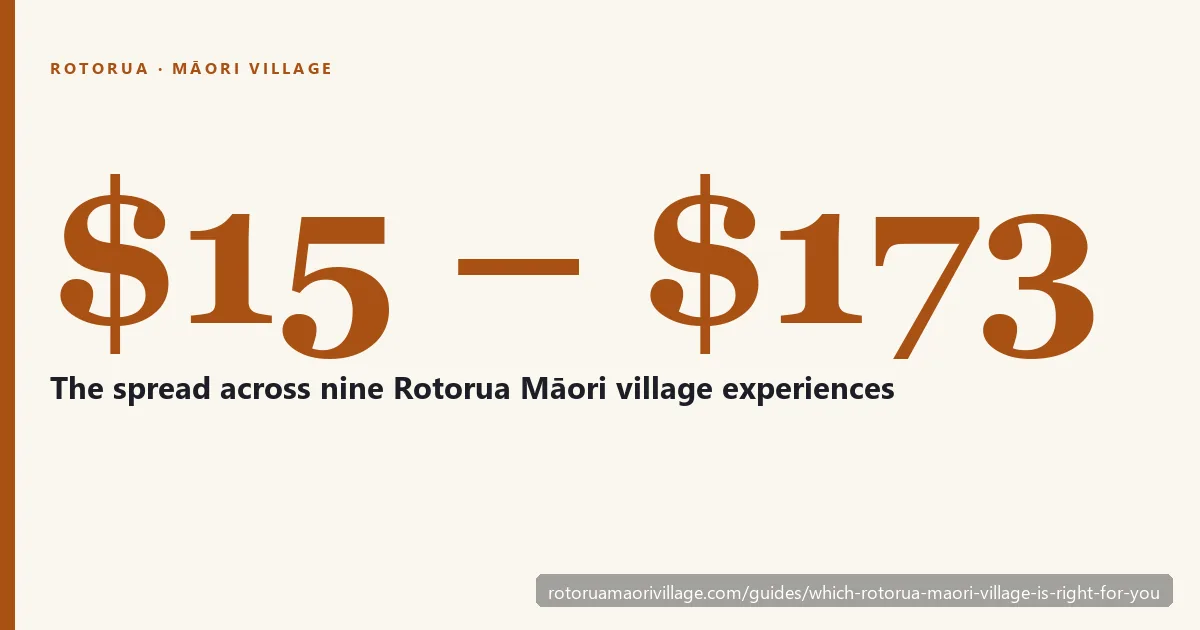
If you book through GetYourGuide, these are the operators’ listings there, in US dollars. Reseller prices move with exchange rates and can lag the operators’ own 1 October price changes, so the official NZD figures above and the US$ figures below won’t always line up.
| Experience | From (US$) | Length | Rating · Reviews | Meal? | Best for |
|---|---|---|---|---|---|
| Buried Village of Te Wairoa | $15 | 1.5–2 hr | 4.5 · 116 | No | The cheapest ticket, and the backstory |
| Whakarewarewa performance only | $21 | 30 min | 4.7 · 232 | No | A haka on a tight budget |
| Whakarewarewa village tour | $29 | 1 hr | 4.7 · 394 | Corn only | Most people |
| Te Puia Te Rā day tour | $56 | 1.5 hr | 4.6 · 459 | No | Geyser + kiwi + carving school |
| Te Puia Te Rā + haka | $85 | 2 hr | 4.8 · 222 | No | The above, plus a performance |
| Mitai Māori Village evening | $101 | 3 hr | 4.7 · 4,250 | Hāngī buffet | The earth oven lifted in front of you |
| Te Puia Te Pō evening | $121 | 2.75 hr | 4.7 · 466 | Hāngī buffet | Pōhutu Geyser after dark |
| Te Pā Tū | $167 | 3.5 hr | 4.8 · 1,463 | Seasonal feast | The best food, transfers included |
| Te Puia Te Pō combo | $173 | 4 hr | 4.6 · 95 | Buffet | Day and night in one ticket |
Ratings drift as reviews land; the booking page always shows the current number. For the evening shows compared on food, transfers and value, see our guide to the best Māori cultural experiences in Rotorua.
The villages, one by one
Whakarewarewa – The Living Māori Village (best overall for real village life)
What it is: a living thermal village, and the home of the Tūhourangi Ngāti Wāhiao people. The village says it is “owned and operated by local residents,” and “today, 21 families live in Whakarewarewa and continue to utilise the same magnificent geothermal resource as their ancestors.”
Access: you can only go in with a guide. The one-hour tours leave at 9am, 10am, 11am, 12pm, 1.15pm, 2pm and 3pm, with 20–30 people per group at most. The village closes to the public at 4pm. You see Pōhutu Geyser from two lookout platforms; there is no access to the geysers themselves from the village.
Price (1 October 2026 – 30 September 2027): guided tour: adult $58, child $29, Gold Card $52.20, family $156.60. Cultural performance (12.30pm daily, 30 minutes): adult $37, child $20, family $102.60. The tour does not include the performance; you buy them separately or as an All Day Pass. There are also combos and self-guided Geothermal Trails, which don’t go to the Pōhutu lookouts.
What you’ll see: steam boxes and cooking pools, bathing spots, an active marae (seen from outside), the WWII Memorial Archway, historic churches, tapu burial grounds (from a respectful distance), and corn cooked in Parekohuru, the village’s largest hot spring. The village says Parekohuru “is used for cooking leaf and root vegetables, seafood and of course our corn on the cob.”
Our take: this is the only organised visit in Rotorua that takes you through a neighbourhood where people live, guided by descendants of the famous guides. Families still live in the houses around you, which is why the guide-only rule matters. It is also the cheapest full village experience.
Address: 17 Tryon Street, Rotorua. Phone 07 349 3463. Our complete Whakarewarewa visitor guide covers tickets, times and food in full. Our breakdown of the village tour →
Ōhinemutu (best free visit and most reflective)
What it is: a living lakeside village of Ngāti Whakaue, the iwi who gifted the land the city of Rotorua was built on. RotoruaNZ says it is “still home to a few hundred descendants” and that people have lived on the site “for over 400 years.”
Highlights:
- Tamatekapua meeting house stands on Te Papaiouru Marae. You may look at it from outside only.
- St Faith’s Anglican Church (completed 1914) looks Tudor from the outside. Inside it is full of Māori carving and tukutuku panels. The Galilee Chapel window, installed in 1967, shows Christ wearing a Māori cloak and appearing to walk on Lake Rotorua.
- Muruika Soldiers’ Cemetery is beside the church. NZHistory says it “contains more than 70 tombs,” mostly of returned 28 (Māori) Battalion soldiers. The graves are raised because the ground is thermal. Sergeant Haane Manahi, who was recommended for the Victoria Cross, is buried here.
Access rules (RotoruaNZ): park at the lakefront and walk in via Mataiawhea Street, near the Lakefront Playground. Use the public toilets at the lakefront. Stay on footpaths. Ariariterangi Street is “not suitable for campervans or buses.” You may walk across the cobbled marae courtyard, but it sometimes closes for private events, and signs will show you another way round. Supervise children, wear shoes, and stay behind the fences. In an emergency, head for high ground.
St Faith’s hours and price: open Monday–Saturday, 10am–12 noon, in summer. From 1 June to 1 October, call ahead (021 0794 298 or 021 835 733). RotoruaNZ lists entry at $7.50 per person, which goes towards restoration; the church’s own site still says $5, so bring cash for either amount.
Is Ōhinemutu free? Yes. Walking the public paths costs nothing. Only St Faith’s charges entry.
Te Pā Tū (best for a polished evening and food)
What it is: a recreated pā in a native tawa forest at 1072 State Highway 5, Tumunui, south of Rotorua. It used to be Tamaki Māori Village and is now owned by Tauhara North No. 2 Trust, an Ahu Whenua Māori land trust of Ngāti Tahu-Ngāti Whaoa, which bought the business in 2018. The winter story is “set in 1800’s Aotearoa… after the 1840 Treaty of Waitangi and before the eruption of Mt Tarawera in 1886.”
What happens: a 3.5-hour seasonal evening. In summer, Tū Te Rā includes a haka pōhiri welcome, kapa haka in a forest amphitheatre, canapés, the hāngī lift and a three-course Māori fusion feast; the dinner is plated, not a hāngī buffet. In winter, Tū Te Ihi celebrates Matariki and starts with an Ahi Tuku fire ceremony. Return transport from central Rotorua is included.
Price: from $280 adult and $115 child, according to newzealand.com and Te Pā Tū’s booking page (its experience page lists NZ$290 adult in summer). Summer departures are 5pm, 6.15pm and 7.30pm.
Our take: the most atmospheric and most expensive option, and the highest-rated on GetYourGuide. It is a staged, recreated pā, very well done, but not somewhere anyone lives. Our breakdown of Te Pā Tū →
Mitai Māori Village (best value hāngī evening)
What it is: the Mitai-Ngatai whānau created a village-style venue on land with history. Their stated aim was “to redevelop the old pā (village) site, showcase Māori culture through Toi Whakaari (performing arts) and to share the lifestyle of Māori.” It is set in native bush with a stream.
Price: the evening cultural experience and dinner buffet takes 3 hours and costs NZ$179 adult (14+) and $110 child (4–13) on Mitai’s dinner page; NZ$169 and $100 appeared on its pages earlier in 2026, so check at checkout. The daytime “Māori Immersive Cultural Village Experience” takes 1.5 hours and costs $105 adult and $70 child.
What happens: warriors paddle a carved waka down the stream, the hāngī pit is opened in front of guests before dinner, there is a full concert, and the evening ends on a bush walk to a sacred spring and wild glow worms. It is the most-reviewed Māori experience in Rotorua by a wide margin. Vegan diets are not catered for, which the operator says plainly.
Our take: a warm, family-run evening with a real hāngī. A traveller review from August 2026 said the wharenui was a temporary shelter during renovation work; we haven’t confirmed this, so ask when you book. Our breakdown of the Mitai evening →
Te Puia: Rotowhio marae and Pikirangi village
What it is: Te Puia is home to the New Zealand Māori Arts and Crafts Institute, and it sits on the other side of the same geothermal valley as Whakarewarewa, with its own entrance on Hemo Road. It includes Rotowhio marae, the carved meeting house Te Aronui a Rua, and Pikirangi, a replica village or pā.
Access: “Entry into the valley is only via a guided tour.” Te Rā is a 90-minute tour costing $105 adult and $52.50 child. It leaves hourly from 9am to 3pm, except 10am. Te Puia describes Te Rā as covering the geothermal valley, the Kiwi Conservation Centre and the Arts and Crafts Institute, and its own news pages mention tours of Rotowhio Marae. To see a performance inside Te Aronui a Rua, you need Te Rā + Haka (normally $142) or the evening Te Pō, the only evening that takes you down to watch Pōhutu erupt after dark. Te Puia’s own pages confirm Pikirangi only as part of the evening Mārama light trail, so don’t book Te Rā just to see the pā.
Our take: Te Puia gives you a working marae and a replica pā, not a lived-in village. It is also the most flexible operator on dietary requirements and wheelchair access. For more detail, see our Whakarewarewa vs Te Puia comparison.
The Buried Village of Te Wairoa (best for history)
What it is: the excavated remains of Te Wairoa, a Māori and European village near Lake Tarawera. Mt Tarawera erupted on 10 June 1886 and buried the village. NZHistory says “up to 150 people, nearly all of them Māori, died,” though the summary on the same page gives about 120, and only the Buried Village and RotoruaNZ use “more than 150.” The Smith family have run the site since Reginald and Violet Smith bought land in the Te Wairoa Valley in 1931, and their sons Basil and Dudley excavated the buried sites. According to the Buried Village’s own family history, it is now managed by Pam (Dudley Smith’s daughter), her son David and his wife Amanda. It is not Māori-owned.
Price and hours: NZ resident adult $25, international adult $30, teen (13–17) $10, children free with a paying adult, family $50, seniors $23. It is listed as open Wednesday–Sunday, 10am–4pm, with last entry at 3.45pm; older sources say daily, so confirm before you go. Allow 1–2 hours. It is at 1180 Tarawera Road. On GetYourGuide the Buried Village ticket was listed from US$15.
The Māori story here: Tūhourangi guides such as Guide Sophia (Sophia Hinerangi) took visitors from Te Wairoa to the Pink and White Terraces. Te Ara notes that tourism wealth meant “pāua-shell eyes on carvings [were] replaced by gold sovereigns.” On the night of the eruption, Guide Sophia “sheltered 62 people in her whare,” according to the National Library of New Zealand, a figure based on her own later estimate. The meeting house Hinemihi, carved in 1880–81 by Wero Tāroi and Tene Waitere, also sheltered people. In 1892 Lord Onslow bought Hinemihi and shipped it to Clandon Park in Surrey, England. On 28 November 2019 the National Trust agreed in principle with Heritage New Zealand to return the original carvings, and a new meeting house is to be built at Clandon. Some visitors’ reviews say the site lacks a balanced Māori perspective, so read up on Tūhourangi history before you go. See what the Buried Village includes →
Other places within day-trip range
- Kohutapu Lodge & Tribal Tours (Lake Aniwhenua, Murupara, about an hour away) offers stays at a living marae, according to newzealand.com, along with weaving and haka workshops. We could only find a third-party package price: from NZ$729 per person for 2 nights in a cottage.
- Marae hire for groups: some local marae can be booked through maraebookingsonline.nz. For example, Paruaharanui Marae at Mourea sleeps 40 for $350 a day. This is venue hire, not a visitor product.
Can you stay overnight in a Māori village?
At the moment you can’t stay overnight in a village in Rotorua itself. Whakarewarewa’s Overnight Marae Stay, where groups slept “within the sacred ancestral meeting house,” is listed as “CURRENTLY NOT AVAILABLE UNTIL FURTHER NOTICE.” Te Pā Tū’s current booking system lists only evening events. For a marae stay today, look at Kohutapu near Murupara, or ask a Rotorua marae about group hire.
Thermal village life: how steam shapes daily life
People in Whakarewarewa have used geothermal heat “for purposes of heating, bathing and cooking” for centuries, according to the village. Instead of heating stones for a hāngī, residents “utilize Mother Nature’s hot steam from our geothermal steam boxes, as well as our mineral pools to cook our kai.” Food goes into the pools in muslin cloth or a flax basket. A 2020 New Zealand Geothermal Workshop paper by Porter and colleagues counted “at least six steam boxes in Whakarewarewa village.” It also notes that Parekohuru and the Korotiotio spring fed the village baths, and that Parekohuru “stopped overflowing in 1987.” Visitors don’t bathe in these pools.
The guiding tradition: after the 1886 eruption, many Tūhourangi moved to Whakarewarewa, which “became a popular visitor destination,” according to Te Ara. Te Ara also records that “instead of providing aid, the government took advantage of the disaster to continue purchasing Māori land.” Guide Sophia carried on guiding at Whakarewarewa and became caretaker of the reserve in 1896. Later guides included Mākereti Papakura, who went on to study anthropology at Oxford, and Guide Rangi (Rangitīaria Dennan), who guided the young Queen Elizabeth and Eleanor Roosevelt. Today’s Whakarewarewa guides describe themselves as their direct descendants.
What happens on a village visit, step by step
- Arrival and gathering. You gather as a group at the entrance or gate. At Te Pā Tū and Mitai, your hosts explain what is about to happen.
- The welcome. At evening venues this is a pōwhiri or haka pōhiri, sometimes opening with a wero (challenge) in which a warrior lays down a token for a chosen visitor “chief” to pick up. The karanga (call) comes next, and the group walks on. Day tours usually start with a shorter mihi whakatau (informal welcome) or just a greeting from your guide.
- Speeches and song. Whaikōrero (speeches) are each followed by a waiata (song). Te Arawa follows tau utuutu, where host and visitor speakers take turns and the hosts speak last.
- Hongi and harirū. You press noses and shake hands. Te Ara notes that “many marae now insist on a return to the traditional method where only hongi and harirū occurs” (no kissing). Follow your hosts’ lead; it is fine to just shake hands if you prefer.
- Guided walk. You’ll see the steam boxes, cooking pools, carvings, the marae (from outside) and the geysers.
- Geothermal cooking. At Whakarewarewa, corn takes about eight minutes in Parekohuru. Evening venues have a hāngī lift.
- Performance. Waiata, poi, tī rākau (stick games) and haka.
- Kai (food). Food lifts the tapu of the welcome. Te Ara notes that the hākari (feast) “lifts the tāpu (sacredness) of the pōwhiri.”
- Poroporoaki (farewell).
What’s staged and what’s everyday? The steam boxes, bathing places, churches, marae and homes at Whakarewarewa and Ōhinemutu belong to people’s everyday lives. Performances everywhere, and the whole of Te Pā Tū, Mitai and Pikirangi, are presentations: professional, often moving, and created for visitors. That doesn’t make them “fake”; kapa haka is a living performing art. But don’t expect to see residents’ private lives at an evening venue.
Photography: photos are usually welcome during performances and on guided walks. Te Ara warns that “some marae do not allow photographs, filming or tape recording without permission.” Don’t photograph people’s homes, residents or children, the urupā, or the inside of a wharenui unless you’ve been told you can. Don’t fly drones. Ask your guide when you’re not sure.
Tikanga (etiquette) in depth
On the marae
- Wait to be welcomed. Te Ara says “you should not just walk onto a marae; you need to be welcomed on.”
- Switch phones off during the pōwhiri. Don’t eat or drink during the welcome, and never walk in front of a speaker on the marae ātea.
- Shoes: take them off before you go into a wharenui.
- Food: never eat or drink inside the wharenui. Wait for karakia (grace). Don’t pass food over anyone’s head, and don’t sit on tables. Food and tapu spaces are kept apart.
- Tapu and noa: tapu means sacred or restricted, and noa means ordinary or free of restriction. Water and food are used to make things noa again. Te Ara advises washing your hands after leaving an urupā.
Roles for men and women in the pōwhiri
Te Ara explains that “in most tribal areas women are kaikaranga (callers) while men play the role of kaikōrero (speakers),” and that “males sit at the front on most marae.” In Te Arawa, the kawa (protocol) traditionally keeps whaikōrero for men. Many Māori see this as a balance of roles, not a hierarchy. The karanga, performed by women, is the first voice that sets the tone and opens the marae ātea. At a visitor pōwhiri you might be asked to choose a male “chief” for your group, and women may be invited to walk in front. Go along with it graciously: it is the hosts’ kawa, and protocols differ between marae.
Koha
A koha is a gift, usually money, from visitors to hosts. On a ticketed tour, your ticket counts as payment. At churches and free sites, a donation is good manners. Te Ara says that in a formal pōwhiri the koha “is usually placed on the ground by the final speaker from the manuhiri.”
Homes, cemeteries and sacred pools
- In Whakarewarewa and Ōhinemutu, the houses are private homes. Don’t peer into windows, walk into yards, or touch steam boxes and baths.
- Urupā (Muruika, and the burial grounds at Whakarewarewa) are not places for photos. Stay outside the fences and keep your voice down.
- Never put food, coins or anything else into thermal pools, and never touch the water. It can be close to boiling, and pools have their own names and histories.
How to visit Ōhinemutu respectfully without a guide
- Park at the lakefront, use the toilets there, and walk in along Mataiawhea Street.
- Stay on footpaths. These are working streets with traffic.
- Cross the marae courtyard quietly. Don’t climb onto the porch of Tamatekapua or go inside. If there’s a tangihanga (funeral) or another event on, use the signed alternative route and don’t take photos.
- Pay the St Faith’s entry fee, dress modestly, and keep quiet inside.
- View Muruika from the path, and don’t take photos of the graves.
- Keep children close. There are active thermal vents next to the paths.
Our guide to what to expect at a Māori village, and how to behave goes through the pōwhiri in more detail.
Which Māori village is right for you? A decision guide
| If you… | Choose | Why |
|---|---|---|
| Want to see real everyday life | Whakarewarewa + Ōhinemutu | The only living villages open to visitors |
| Are on a tight budget | Ōhinemutu (free) + Whakarewarewa tour ($58), or the Buried Village and the Whakarewarewa performance | Lowest cost for the most authentic experience |
| Have kids | Whakarewarewa (under-5s free, corn in the pool) or Mitai | Short, hands-on and lively |
| Have limited mobility | Ōhinemutu lakefront and St Faith’s; Te Pā Tū and Mitai include transport | Te Puia says you may need to “climb and descend stairs and walk on unpaved or uneven terrain” (though it lends wheelchairs); Whakarewarewa paths are uneven and steamy |
| Want a show and a feast | Te Pā Tū (premium) or Mitai (value) | A full evening with hāngī |
| Want the geyser, the kiwi and the carving school | Te Puia | Not a village, but the closest view of Pōhutu (more kiwi options) |
| Have only an evening free | Te Pā Tū, Mitai or Te Puia’s Te Pō | Whakarewarewa closes at 4pm |
| Prefer self-guided | Ōhinemutu, Buried Village | No guide needed |
| Love history and volcanoes | Buried Village + Whakarewarewa | Two halves of the same 1886 story |
For families and access needs in more detail, see our guide to Rotorua Māori villages with kids and accessibility needs.
Know before you book
Whakarewarewa and Te Puia are different places with different gates. They share one geothermal valley and are constantly confused for each other. Whakarewarewa’s entrance is on Tryon Street; Te Puia’s is on Hemo Road. Booking one expecting the other costs an afternoon.
Mitai is the evening built around the earth oven. The pit is opened in front of guests before dinner. Te Puia’s buffet is cooked in the traditional style, and Te Pā Tū serves a plated menu (its summer programme lists a hāngī lift; its winter menu includes in-ground hāngī). If watching the pit open is the thing you came for, Mitai is the safest booking.
Dietary requirements vary. Mitai says it can’t cater for vegans. Te Puia is the most flexible on vegetarian and gluten-free; Te Pā Tū offers vegetarian, pescatarian and gluten-free options but its kitchen is not coeliac-approved. Flag any requirement at booking, not on the night.
The village tour does not include a performance. Whakarewarewa sells the two separately. You can combine them at the gate or with the All Day Pass.
Evening sittings sell out first in January and February. Free cancellation up to 24 hours before on GetYourGuide means holding a date early costs nothing. See the seasonal guide.
Whakarewarewa and Ōhinemutu are somebody’s street. Stay on the paths, keep clear of fenced ground, and ask before photographing people or homes.
Sample itineraries
One perfect village day
- 8.30am: walk through Ōhinemutu and the lakefront (St Faith’s opens at 10am in summer).
- 10am or 11am: Whakarewarewa guided tour, then the 12.30pm performance, and a corn or hāngī lunch in the village.
- Afternoon: rest, or soak in the hot pools.
- Evening: Te Pā Tū or Mitai, both with pick-up from town.
Half day, low budget: Ōhinemutu (free) + a Whakarewarewa tour ($58) = under NZ$70 per adult.
History loop: Whakarewarewa in the morning, then a 15-minute drive to the Buried Village, open Wednesday–Sunday (allow 1–2 hours).
Practical tips
- Getting there: Ōhinemutu is about a 10-minute walk from the city centre, according to RotoruaNZ. Whakarewarewa is at 17 Tryon Street, about 3 km south of the centre, and Te Puia is at 20 Hemo Road. Te Pā Tū and Mitai include transfers from town (Mitai’s are limited). The Buried Village needs your own car or a tour.
- Weather: the steam is thickest and most photogenic on cold mornings. Thermal paths get slippery in rain.
- What to wear: comfortable walking shoes (Whakarewarewa asks for them), layers, and a rain jacket. Dress modestly for St Faith’s and any marae welcome.
- Smell: expect a sulphur (“rotten egg”) smell. It is harmless.
- Booking: book evening venues and summer tours ahead of time. Ōhinemutu doesn’t need booking.
Hinweis für deutschsprachige Besucher (“Maori Dorf Rotorua”): Das bekannteste bewohnte Maori-Dorf ist Whakarewarewa (nur mit Führung, ca. 1 Stunde, ab NZ$58). Ōhinemutu am Seeufer ist kostenlos zu Fuß zu besichtigen, bitte auf den Wegen bleiben. Te Pā Tū und Mitai sind abendliche Kultur- und Hāngī-Erlebnisse in nachgebauten Dorfanlagen. Führungen sind in der Regel auf Englisch.
Frequently asked questions
Is there a real Māori village in Rotorua?
Yes. Whakarewarewa and Ōhinemutu are both living villages where Māori families live today.
Is Whakarewarewa a real village?
Yes. The operator says 21 families live there, and the village is owned and run by its residents.
Do people still live in Whakarewarewa?
Yes. That’s why you can only visit with a guide, and why the village closes to the public at 4pm.
Which Rotorua Māori village is best for first-time visitors?
The Whakarewarewa village guided tour, at NZ$58 for an hour. It is the only organised visit to a village where people still live, and it gives you the context that makes the evening shows make sense afterwards.
What is the cheapest Māori experience in Rotorua?
Walking through Ōhinemutu is free; St Faith’s Church charges a few dollars. Among ticketed options, the Whakarewarewa cultural performance is NZ$37, and on GetYourGuide the Buried Village is listed from US$15 and the performance from US$21.
Is Ōhinemutu free?
Walking the public paths is free. St Faith’s Church charges entry: $7.50 according to RotoruaNZ, or $5 on the church’s own site.
Can you visit a marae?
Yes, but only with a welcome or through an operator. Te Puia’s Rotowhio marae and the marae at Whakarewarewa and Ōhinemutu can be seen from outside or on guided visits. Tamatekapua is viewed from outside only.
What is a pā?
Traditionally, a fortified village. Today the word also means a Māori settlement, especially one around a marae.
Is Mitai or Te Pā Tū better?
They are close in quality and different in emphasis. Mitai has about three times the review volume and is built around opening the hāngī pit in front of guests. Te Pā Tū rates fractionally higher, serves a plated seasonal menu instead of a buffet, and includes hotel transfers for every guest, for about NZ$100 more per adult.
Which Māori village is best for kids?
Whakarewarewa is best for daytime visits, with short tours, corn cooked in a hot pool and under-5s free. Mitai is best in the evening.
Can I do more than one in a day?
Comfortably. A common pairing is the Whakarewarewa village tour or Te Puia in the daytime and Mitai or Te Pā Tū in the evening. Whakarewarewa plus the Buried Village makes a good history day.
Do I need to book in advance?
Daytime tours can usually be booked same-day outside peak season. Evening sittings at Mitai, Te Pā Tū and Te Puia fill first, particularly across January and February and over Christmas and New Year.
Can you stay overnight in a Māori village?
Not in Rotorua at the moment. Whakarewarewa’s marae stay is suspended. Kohutapu near Murupara offers marae stays.
Is it respectful to visit?
Yes. These communities have welcomed visitors for well over a century, and tourism helps support them. Being respectful means following the guide, protecting residents’ privacy, and following tikanga.
Ready to book? See the living village at Whakarewarewa →
Related reading:
- The best Māori cultural experiences in Rotorua, compared
- Whakarewarewa Living Māori Village: the complete visitor guide
- Whakarewarewa vs Te Puia — which one, if you only pick one
- What to expect, and how to behave, at a Māori village
- The best time of year to visit
- With kids, and with accessibility needs
- Things to do in Rotorua
- Where to see kiwi in Rotorua
- Rotorua geothermal parks compared
See the Village That People Still Live In
Whakarewarewa's guided tour is led by descendants of the families who have guided visitors here for six generations — through streets where the cooking is still done in the ground. Free cancellation up to 24 hours before.
Check Dates & Prices