Whakarewarewa vs Te Puia — Which One Should You Visit?
Te Puia or Whakarewarewa? Compare 2026–27 prices, Pōhutu Geyser access, kiwi, haka, Te Pō and Mārama, with a straight verdict and plans for doing both in one day.
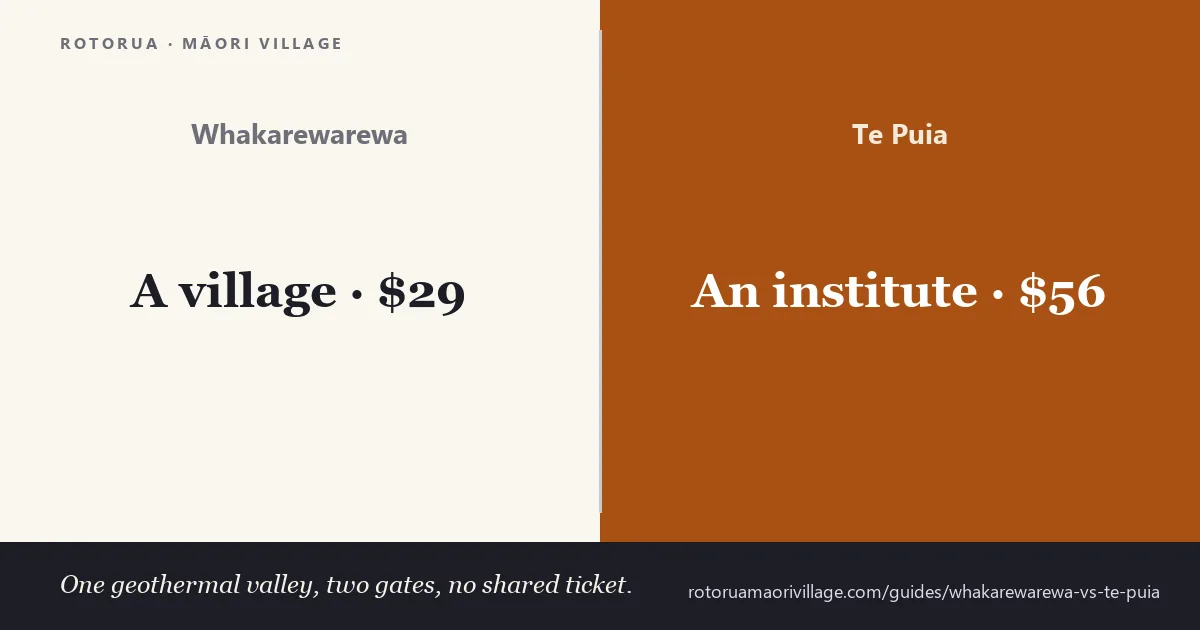
These are the two Rotorua attractions visitors most often mistake for each other. Both sit in the same Te Whakarewarewa geothermal valley and both look out on Pōhutu Geyser, but they are separate attractions with separate tickets, and you can’t walk from one to the other. Choose Te Puia if you want the closest views of Pōhutu, a kiwi house, the Māori carving and weaving schools and an evening option. Choose Whakarewarewa – The Living Māori Village if you want to see an inhabited geothermal village, hear its history from the families who live there, and pay less: the village’s official price list puts its guided tour at NZ$58 per adult from 1 October 2026, against NZ$105 for Te Puia’s Te Rā tour.
Check Availability
Last checked 1 October 2026. Prices are in New Zealand dollars and come from the operators’ own websites (tepuia.com and its booking site, and whakarewarewa.com) unless stated otherwise. Both operators change prices and run seasonal promotions, so confirm before you book. This site is an independent guide and isn’t owned by or affiliated with either attraction.
The short answer
Te Puia is the better pick for most first-time visitors who want the big Rotorua geyser visit in one ticket. That ticket covers close-up Pōhutu views, a nocturnal kiwi house, master carvers and weavers at work, and a haka in a carved meeting house. Whakarewarewa is the better pick if you care most about living Māori culture and value for money. It is smaller and more personal, guided by descendants of Rotorua’s original guides, and noticeably cheaper.
If you have a full day, do both. They complement each other more than they overlap.
Key facts at a glance
- Same valley, different attractions. Both are in the Te Whakarewarewa geothermal valley, which Tourism New Zealand describes as a “5 minutes drive from the Rotorua isite and city centre”. Te Puia’s entrance is at 20 Hemo Road and Whakarewarewa’s is at 17 Tryon Street. There is no gate between them.
- Separate tickets, no walk-through. A gate between the two sites was locked on 19 December 1997 after a land-payment dispute, and there is no combined ticket. Nothing you buy at one admits you to the other.
- Ownership: Te Puia is owned by the iwi-based Te Puia NZMACI Limited Partnership under the New Zealand Māori Arts and Crafts Institute Vesting Act 2020. Whakarewarewa is owned and run by its residents, the Tūhourangi Ngāti Wāhiao people, through a charitable trust.
- Both guided by day: Te Puia’s daytime entry is only by guided tour. The Whakarewarewa village can also only be entered with a guide, though its separate Geothermal Trails are self-guided.
- Cheapest entry (adult, 2026–27): Whakarewarewa’s guided tour costs NZ$58. Te Puia’s Te Rā guided experience costs NZ$105.
- One geyser, two vantage points: at Te Puia you walk to the geyser terrace. At Whakarewarewa you see Pōhutu from two lookout platforms across the valley.
Te Puia vs Whakarewarewa: side-by-side comparison
| Te Puia | Whakarewarewa – The Living Māori Village | |
|---|---|---|
| What it is | Geothermal park and home of the NZ Māori Arts and Crafts Institute (NZMACI) | Inhabited Māori village on the geothermal field; about 21 families live on site |
| Owned / run by | Te Puia NZMACI Limited Partnership (iwi-owned since the 2020 Vesting Act) | Village residents (Tūhourangi Ngāti Wāhiao) via a charitable trust |
| Entrance | 20 Hemo Road | 17 Tryon Street |
| Hours | 8:45am–5pm daily, plus evening experiences | 8:30am–4pm daily (admissions to 3:30pm); closed 24–25 December |
| Cheapest adult ticket | Te Rā guided experience, NZ$105 | Guided village tour, NZ$58 (from 1 Oct 2026) |
| Tour + performance (adult) | Te Rā + Haka, NZ$142 (standard price) | Tour NZ$58 + performance NZ$37 = NZ$95 |
| Most complete day ticket | Te Rā Combo (tour, haka, hāngī lunch), NZ$196.60 | All Day Pass (tour, performance, Geothermal Trails), NZ$123.30 |
| Child / family | Child (5–15) about half the adult price; family tickets on some products | Child NZ$29; family (2+4) NZ$156.60 for the tour |
| Guided? | Yes, all day visits are guided (90-minute Te Rā tour); you can stay on afterwards | Village is guided only (1 hour); trails are self-guided |
| Pōhutu Geyser | Walk to the geyser terrace; closest public access | Seen from two lookout platforms; no access to the geysers |
| Mud pools & hot springs | Yes, along the valley tour | Yes, through the village and on the Geothermal Trails |
| Geothermal cooking | Geysers and mud pools only | Yes, in daily domestic use; corn cooked in the Parekōhuru pool on the tour |
| Kiwi | Yes, nocturnal Kiwi Conservation Centre (sightings not guaranteed) | No |
| Carving & weaving | Yes, national wood carving, stone and bone carving, and weaving schools (NZMACI) | Village crafts and history; no formal schools on the tour |
| Food | Pātaka Kai Restaurant (hāngī buffet lunch and dinner), Hiakai Café | Hāngī meals, hāngī pies, and corn cooked in the Parekōhuru hot pool |
| Performance | Pōhiri, waiata, poi and haka in the carved meeting house Te Aronui a Rua | 30-minute show at 12:30pm daily (extra shows in summer) |
| Evening options | Te Pō (dinner + haka), Te Pō Combo, Mārama light trail, Dinner + Mārama | None; the village closes to the public at 4pm |
| Time to allow | 2–3 hours by day; 2¾–4½ hours for evening combos | 1–1.5 hours for the tour; 3–4 hours with show, trails and lunch |
| Group size | Not published; some reviewers mention large groups | 20–30 guests per tour (operator’s stated maximum) |
| Accessibility | Wheelchair accessible, with free loan wheelchairs and a train back up from the valley; Mārama is not wheelchair or pram friendly | Village paths are uneven in places; ask ahead |
| Payment | Cashless (cards and mobile wallets) | Cards accepted; check on arrival |
| Tripadvisor rating | 4.4/5 (about 6,180 reviews) | 4.5/5 (about 3,400 reviews; #4 of 68 things to do in Rotorua) |
| Best for | Geyser and kiwi seekers, carving fans, evening visitors, travellers short on time who want everything in one ticket | Culture-focused travellers, budget travellers, families wanting a smaller, personal tour |
On GetYourGuide (prices in US dollars, which move with exchange rates and may lag the operators’ own changes): the Whakarewarewa guided tour was listed from US$29 and the village performance from US$21; Te Puia’s Te Rā day tour from US$56, Te Rā with the haka from US$85, Te Pō from US$121 and the Te Pō day-and-evening combo from US$173. All of these carry free cancellation up to 24 hours ahead.
Why there are two attractions in one valley (and why it confuses everyone)
Te Puia and Whakarewarewa were once experienced as one place. For generations, guides from the Tūhourangi Ngāti Wāhiao village led visitors through the whole valley. The NZ Māori Arts and Crafts Institute, set up by the Crown under a 1963 Act, later ran the visitor operation on the geyser side.
The split happened in 1997. According to the Rotorua Daily Post (NZ Herald), the gate between the two attractions “was locked by an unknown person on December 19, 1997”, amid a dispute over NZ$331,158 that the Rahui Lands Trust (then representing the village) said the Institute owed for using a hectare of village land. The village launched its own tourism venture in February 1998. NZMACI’s visitor business later rebranded as Te Puia.
Reconciliation talk hasn’t changed the visitor reality. In 2007 the Rotorua Daily Post reported that the two sides had reconciled and were planning a joint venture and the removal of the gate. As of October 2026 they still operate separately, with separate tickets and no public walk-through.
The ownership link that surprises people. Under the 2020 Vesting Act, Te Puia passed from the Crown to the Te Puia NZMACI Limited Partnership. That partnership is owned 50% by the Wāhiao Tūhourangi o Whakarewarewa Trust, 25% by the Pukeroa Oruawhata Trust (Ngāti Whakaue), and 25% by the HTK Te Puia Trust (the Ngāti Whakaue hapū of Ngāti Hurungaterangi, Ngāti Taeotū and Ngāti Te Kahu). So a Whakarewarewa-linked trust is a major owner of Te Puia, yet the two visitor attractions are managed and ticketed independently. They are neighbours with shared whakapapa (ancestry), not a single business.
Te Puia in depth
What is Te Puia?
Te Puia is an iwi-owned geothermal and Māori cultural attraction covering about 60 hectares of the Te Whakarewarewa valley. It contains Pōhutu Geyser, the New Zealand Māori Arts and Crafts Institute, the Kiwi Conservation Centre, Rotowhio Marae and the Pātaka Kai restaurant. Te Puia’s own listings say 60 hectares, as does Air New Zealand’s destination guide, which describes “the 60-hectare Te Whakarewarewa geothermal valley” with “over 500 bubbling geothermal features”; some third-party guides say 70. The name comes from the fortified pā (settlement) of Te Puia that once stood in the valley.
The New Zealand Māori Arts and Crafts Institute (NZMACI)
NZMACI is a national school for traditional Māori arts, based inside Te Puia. The Rotorua Māori Arts and Crafts Institute Act 1963 created it, and a 1967 amendment made it a national institute. Its schools are:
- Te Wānanga Whakairo Rākau, the National Wood Carving School
- Te Takapū o Rotowhio, the National Stone and Bone Carving School
- Te Rito o Rotowhio, the National Weaving School
The Te Rā tour takes you into the wānanga, where you can watch students and tutors at work. Watching a school at its benches is a different thing from watching a demonstration staged for visitors. The 2020 Vesting Act carried over the Institute’s six statutory functions from the 1963 Act, including training in whakairo (carving) and raranga (weaving).
One recent change matters for the school itself: Te Puia says Government Covid-era support for NZMACI ended on 31 March 2025, and it has introduced student fees. The Vesting Act confirms NZMACI’s national role but doesn’t fund it.
Pōhutu and the Prince of Wales Feathers geysers
Pōhutu is the largest active geyser in the Southern Hemisphere. Te Puia’s FAQ says it “erupts up to 20 times every day” and “often reaches heights of up to 30 metres”, and Tourism New Zealand gives the same figure, adding that it once erupted non-stop for more than 250 days. No eruption is guaranteed at any given moment. Next to it, the Prince of Wales Feathers (Te Tohu) geyser usually starts first and is a reliable sign that Pōhutu is about to go. Te Puia’s tour walks you down to the geyser terrace, the closest public viewing point in the valley.
Kiwi Conservation Centre
Te Puia has a purpose-built nocturnal kiwi house, opened in 2019, that reverses day and night so the birds are active during visiting hours. Our guide to where to see kiwi in Rotorua compares it with the National Kiwi Hatchery at the Agrodome. Kiwi have lived at Te Puia since the 1970s, when it started as a rehabilitation centre for injured wild birds; Te Puia says its original nocturnal house was built in 1976. Te Puia is one of 13 New Zealand parks and zoos in the DOC-overseen captive management programme for North Island kiwi. Its first chick in 15 years, Manawa, hatched in November 2024 from an egg incubated at Save the Kiwi’s Gallagher Kiwi Burrow in Taupō, and now lives in one of the display enclosures.
Two things to know before you go:
- Phones must not be used inside the kiwi house.
- Te Puia states that kiwi sightings can’t be guaranteed.
Marae and the cultural performance
The haka performance takes place in Te Aronui a Rua, the carved meeting house on Rotowhio Marae inside Te Puia. It includes a pōhiri (ceremonial welcome), waiata (song), mōteatea (chant), poi and haka.
Note: Te Pākira Marae, with the Wahiao meeting house, belongs to the Whakarewarewa village, not Te Puia. You see it on the village tour.
Is every Te Puia visit guided now?
Yes. During the day, every visit to Te Puia is guided. Entry to the valley is only by tour. The Te Rā tour lasts 90 minutes, and you’re welcome to stay afterwards to watch another eruption, revisit the kiwi, eat or shop. In the evening, Mārama is hosted rather than guided, so you explore at your own pace.
Te Puia experiences, prices and times (2026–27)
| Experience | What’s included | Adult | Child (5–15) | Family | Times / duration |
|---|---|---|---|---|---|
| Te Rā Guided Experience | 90-min guided tour: geothermal valley and Pōhutu, Kiwi Conservation Centre, NZMACI | NZ$105 | NZ$52.50 | — | Hourly departures by day; 90 min |
| Te Rā + Haka Combo (most popular day option) | Te Rā tour + 30-min performance in Te Aronui a Rua | NZ$142 | NZ$76.50 | NZ$383.40 (2+2 or 2+3) | Departs 9am, 10am, 11am, 12pm; about 2 hrs |
| Te Rā Combo | Te Rā tour + performance + hāngī buffet lunch | NZ$196.60 | NZ$111 (listed as child 5–16) | — | Daily 11am–2pm |
| Hāngī Buffet Lunch (add-on) | Lunch buffet at Pātaka Kai Restaurant | NZ$60 | Not published | — | 11:30am–2pm (last seating 1pm; 90-min dining) |
| Te Pō | Hāngī buffet dinner + 45-min performance + hot chocolate by Pōhutu | NZ$203 | NZ$140 | — | Daily from 5:30pm; about 2¾ hrs |
| Te Pō Combo (most popular night option) | Te Rā tour + hāngī dinner + performance + hot chocolate | NZ$290 (standard) | NZ$181 | — | Daily 4pm; about 4½ hrs |
| Hāngī Buffet Dinner only | Dinner at Pātaka Kai | NZ$103 | NZ$72 | — | 5:30pm or 7:15pm sittings |
| Mārama: Geyser Light Trail | Hosted, self-paced 1.5 km night walk through 10 light scenes | NZ$49 | NZ$25 | NZ$132.30 (2+2) | Seasonal; entries every 15 min (7–9pm in September 2026); about 60 min |
| Dinner + Mārama | Hāngī buffet dinner + Mārama entry | NZ$146 | NZ$99 | — | 7:15pm dinner, 8:45pm Mārama (from 28 September 2026) |
Under-5s go free with a paying adult on all products.
Promotions: Te Puia ran a winter promotion until 28 September 2026: Te Rā + Haka at NZ$105 per adult (NZ$52.50 per child; family NZ$283.50) and the Te Pō Combo at NZ$203 per adult. Its booking page said Te Rā + Haka pricing “will revert back to $142 per adult” afterwards. It ran a similar winter deal in 2025, so watch for one again from around June 2027. Te Puia’s own pages sometimes still show promotional prices after a promotion ends, so check the price at checkout.
Free shuttle: complimentary hotel pick-ups may be available for Te Pō and Te Pō Combo guests from selected Rotorua accommodation. Request one by 1pm on the day.
Local discount: the Whānau Card costs NZ$39 for Rotorua residents and NZ$89 for other New Zealand residents. It gives discounts on online bookings plus a birthday voucher.
Private or premium tours: Te Puia’s own booking site lists no private tour as of October 2026. Some resellers advertise “premium” or “private night” Te Puia tours; treat these as unverified and confirm directly with Te Puia.
Te Pō: is the evening experience worth it?
Te Pō is worth it if you want dinner and a show in one booking and you value the setting. It is less compelling if price is your main concern. Tripadvisor rates it 4.6–4.7 out of 5 across roughly 70–77 reviews. Reviewers consistently praise the performance, the guides and the hāngī buffet (lamb, chicken and vegetables cooked in a hāngī, plus mānuka-smoked salmon, mussels and a dessert buffet). The most common complaint is price; one reviewer felt it should cost “~$50” less per person.
Our take: the Te Pō Combo at its standard NZ$290 is a big spend. Te Pō on its own (NZ$203) after a daytime Te Rā tour on another day often makes more sense, or book the combo during the winter promotion.
Mārama: Geyser Light Trail
Mārama is a hosted night walk that lights the geysers and valley paths with colour, sound and interactive art. A refreshed “Mārama 2.0” relaunched on 26 June 2026. It is a 1.5 km self-paced loop of about 60 minutes, with a stop on the heated terrace overlooking Pōhutu, and it finishes through Pikirangi Village.
Before you book, note:
- It is seasonal.
- It includes strobe and laser effects, so it isn’t suitable for people with photosensitive epilepsy.
- Te Puia says it isn’t suitable for wheelchairs or prams because of unpaved paths.
Shopping and food at Te Puia
- Oha Gift Store: souvenirs, ponchos and more.
- Āhua Gallery: sells work from the carving and weaving schools, including pounamu (greenstone), bone, wood carvings and woven kete (bags). Commissions are possible.
- Food: Pātaka Kai Restaurant & Bar and Hiakai Café. You don’t need a tour ticket to shop or eat.
- Payment: Te Puia is fully cashless.
Our breakdown of Te Rā + haka →
Whakarewarewa – The Living Māori Village (summary)
For the full guide, see our Whakarewarewa Living Māori Village: The Complete Visitor Guide.
Whakarewarewa is an inhabited village where Tūhourangi Ngāti Wāhiao families still cook in steam boxes and hot pools, bathe in geothermal water and heat their homes with it. This is the thing Te Puia cannot show you, because nobody lives there. Their ancestors began guiding visitors in the 19th century, including to the Pink and White Terraces before the 1886 Tarawera eruption, and today’s guides are their descendants.
What you’ll see
- The Parekōhuru hot pool, where you taste corn cooked in it
- Steam vents and mud pools
- Te Pākira Marae and the Wahiao meeting house
- Historic churches and the WWII memorial archway
- Pōhutu and the Prince of Wales Feathers erupting, seen from two lookout platforms
Whakarewarewa prices (1 October 2026 to 30 September 2027)
| Experience | Adult | Child (5–15) | Senior (Gold Card) | Family | Times |
|---|---|---|---|---|---|
| Guided Village Tour (1 hr) | NZ$58 | NZ$29 | NZ$52.20 | NZ$156.60 (2+4) | 9am, 10am, 11am, 12pm, 1:15pm, 2pm, 3pm |
| Cultural Performance (30 min) | NZ$37 | NZ$20 | NZ$33.50 | NZ$102.60 | 12:30pm daily; extra shows in summer |
| All Day Pass (tour + performance + Geothermal Trails) | NZ$123.30 | NZ$63 | — | — | Tour of your choice + 12:30pm show |
| Self-Guided Geothermal Trails | NZ$39 | NZ$19 | NZ$35 | NZ$104.50 | Last entry 3:15pm; allow 45–90 min |
Under-5s are free. The village’s homepage was still showing older trail prices (NZ$42 adult) on 1 October 2026; the figures above are from the 2026–27 experience pages, so confirm at booking.
Food: a geothermal hāngī meal (beef, chicken, potato, kūmara and vegetables), hāngī pies, and corn cooked in Parekōhuru are sold at the village café. Prices aren’t published on the official site, so check on the day.
Good to know:
- The village is closed to the public from 4pm.
- The Geothermal Trails don’t go near Pōhutu.
- The cultural performance is booked separately from the tour, a common surprise in reviews.
- The village takes up to 20–30 guests per tour and up to 120 per performance.
Our breakdown of the Whakarewarewa tour →
Which is more authentic?
Both are authentic in different ways, so there is no winner to declare here. Te Puia is iwi-owned and is the national home of traditional carving and weaving, with a formal pōhiri in a carved meeting house. Whakarewarewa’s authenticity is about daily life: you are a guest in a community’s home, guided by people whose families have hosted visitors for generations.
If “authentic” to you means seeing how people live today, choose Whakarewarewa. If it means seeing taonga (treasured arts) made by master practitioners, choose Te Puia. For the evening venues too, see Rotorua’s best Māori cultural experiences, which compares Te Pā Tū, Mitai and Te Pō.
Decision guide: which should you choose?
Choose Te Puia if…
- Pōhutu up close is your top priority, especially for photography.
- You want to see kiwi, and this may be your only chance on your trip.
- You’re interested in carving, weaving, pounamu or buying original Māori art.
- You want an evening experience (Te Pō, Mārama) or a hāngī dinner with a show.
- You’re short on time and want geysers, kiwi, culture and food in one ticket.
- You need step-free access (free wheelchairs, plus a train back up from the valley).
Choose Whakarewarewa if…
- You want to understand how Māori live with geothermal energy today.
- You prefer smaller groups (20–30 at most) and storytelling from residents.
- Budget matters: the tour and show cost NZ$95 against NZ$142 for Te Puia’s equivalent.
- You’re happy seeing Pōhutu from a lookout instead of the terrace.
- You’d love to eat corn cooked in a boiling spring.
- You have an hour, not a half day.
By traveller type
| Traveller | Our pick | Why |
|---|---|---|
| Families with young kids | Te Puia (kiwi wins) or Whakarewarewa (cheaper, shorter) | Te Puia offers kiwi and a train ride; Whakarewarewa has a 1-hr tour and the corn is a hit |
| Budget travellers | Whakarewarewa | Tour NZ$58; All Day Pass NZ$123.30 vs Te Rā Combo NZ$196.60 |
| Photographers | Te Puia (plus Mārama at night) | Closest geyser access; night lighting |
| Culture-focused visitors | Both; if only one, Whakarewarewa | The living village plus Te Puia’s arts schools give the full picture |
| Travellers short on time | Te Puia Te Rā + Haka (2 hrs) | Everything in one slot |
| Wheelchair users | Te Puia (daytime) | Stated wheelchair access and loan chairs |
For families and access needs in more detail, see our guide to Rotorua Māori villages with kids and accessibility needs. If you’re also weighing the evening venues, Mitai and Te Pā Tū, our guide to which Rotorua Māori village is right for you compares all four.
Can you do both in one day?
Yes, and it is the best way to understand the valley. The village’s tours run 9am–3pm and it closes at 4pm, while Te Puia runs evening experiences, so do Whakarewarewa first and Te Puia second. The village also gives you the human context (who lives here, what the ground does, why this became New Zealand’s first visitor destination), and Te Puia’s geology and craft school land better once you have it. The entrances are on different streets, so drive, take a taxi or walk round, and allow 10–15 minutes to move between them.
Doing both still costs less than one seat at Te Pā Tū’s evening.
Half-day plan (about 4–5 hours)
- 9:00am: Whakarewarewa guided tour (1 hr). Try the hot-pool corn.
- 10:15am: coffee or a hāngī pie at the village café.
- 11:00am: transfer to Te Puia (20 Hemo Road).
- 11:30am or 12:00pm: Te Rā + Haka (about 2 hrs). Finish around 2pm.
- Cost (adult, standard prices): NZ$58 + NZ$142 = NZ$200.
Full-day plan
- 9:00am: Whakarewarewa tour.
- 10:15am: Self-Guided Geothermal Trails.
- 12:30pm: village cultural performance.
- 1:15pm: hāngī lunch at the village. (The All Day Pass at NZ$123.30 covers the tour, trails and show.)
- 2:30pm: transfer to Te Puia.
- 3:00pm: Te Rā guided experience (90 min), then stay to watch Pōhutu and visit the Āhua Gallery.
- Evening option A: stay for Te Pō (5:30pm, NZ$203), which includes a second performance.
- Evening option B: skip Te Pō, come back for Mārama after dark (NZ$49) and eat in town. You’ve already seen the village haka.
- Cost (adult): NZ$123.30 + NZ$105 + NZ$49 = about NZ$277 with option B.
Tip: avoid paying for two haka performances unless you love kapa haka. The village show and Te Puia’s differ in style and setting, but they overlap a lot.
Practical tips for visiting Te Puia
Getting there:
- Car: Te Puia is at 20 Hemo Road, about 5 minutes’ drive south of the city centre. Search “Te Puia, Rotorua” in Google Maps.
- Bus: the Rotorua City Ride runs every 30 minutes until 6pm from opposite the Pullman Hotel.
- Taxi or rideshare: Uber and local taxis operate in Rotorua.
Parking: free, with spaces in the main car park and at the southern end of the site.
Opening hours: 8:45am–5pm daily. The last tour departs at 4pm, and dinner sittings are at 5:30pm and 7:15pm. Arrive 15 minutes before your tour.
Accessibility: Te Puia says the valley is wheelchair accessible and offers complimentary wheelchairs at the ticket office. Most of the tour is walking, but a train brings you back up from the valley. Some third-party accessibility reviews mention steep sections, so ask staff for the best route. Mārama is not wheelchair or pram friendly.
What to wear: comfortable, closed walking shoes and layers. Te Puia operates rain or shine; bring a rain jacket, or buy a poncho at the gift store. Evenings, and Mārama especially, get cold.
Photography: allowed around the valley, but no phones in the kiwi house. Ask before photographing people, and follow your guide’s lead inside the wharenui.
Cultural etiquette:
- During the pōhiri, stay with your group, don’t eat or drink, and listen to your guide about when to enter.
- Shoes come off in some meeting houses.
- Stay on marked paths. The ground is dangerous, with boiling water and thin crust.
Our guide to what to expect at a Māori village, and how to behave covers the pōhiri step by step.
Best time of day:
- Mornings: usually quieter and best for photos, as the steam catches the light.
- Late afternoon: pairs well with Te Pō.
- Pōhutu: erupts throughout the day, so allow at least 30 minutes after your tour for a better chance of catching a big eruption.
How long to allow:
- 2–3 hours for Te Rā or Te Rā + Haka
- About 3 hours for the Te Rā Combo
- 2¾ hours for Te Pō
- 4½ hours for the Te Pō Combo
- About 1 hour for Mārama
Payment: cards and mobile wallets only (Visa, Mastercard, Amex, Apple Pay, Google Pay, Alipay, WeChat Pay, UnionPay, JCB), with no transaction fees.
Booking channels:
- Direct on tepuia.com, which usually has the latest promotions.
- Resellers such as GetYourGuide, Viator, Expedia and Bookme. These sometimes offer free cancellation or discounts, but prices fluctuate with exchange rates.
Reviews: what visitors say
Te Puia (Tripadvisor 4.4/5, about 6,180 reviews; Te Rā on GetYourGuide 4.6/5, 459 reviews):
- Praised: the guides, the kapa haka, the geyser terrace, and the sense of getting three experiences in one.
- Criticised: price, and the tour feeling rushed when groups are large. One January 2026 reviewer called it “rushed, surface-level… especially given that the guided tour is the only option.”
- Our read: the experience itself is strong. Value is the debate, which is why the promotions and the Te Rā + Haka combo are the best buys.
Whakarewarewa (Tripadvisor 4.5/5, about 3,400 reviews; guided tour product 4.7/5, about 400 reviews):
- Praised: guides who grew up in the village, the intimacy, and the hot-pool corn.
- Criticised: the performance costing extra, and some feeling it is pricey for a short visit.
- Our read: excellent value for the personal connection. Book the tour and show together.
Ratings are snapshots from late September 2026 and change constantly.
Frequently asked questions
How much does Te Puia cost in 2026?
At standard prices, Te Puia’s Te Rā guided experience costs NZ$105 per adult and NZ$52.50 per child (5–15). Te Rā + Haka costs NZ$142 per adult and NZ$76.50 per child. Te Pō (dinner and haka) is NZ$203 per adult. Under-5s are free. Te Puia runs seasonal promotions, including a winter deal that ended on 28 September 2026.
Is Te Puia worth it?
Yes, if you want close-up geyser views, kiwi and the carving and weaving schools in one visit. It is Rotorua’s most complete single geothermal-and-culture ticket. If budget is tight or you mainly want living culture, Whakarewarewa gives better value.
How long do you need at Te Puia?
Allow 2–3 hours for a daytime visit: the 90-minute tour, plus the haka if booked, plus time to linger. Evening experiences take 2¾ hours (Te Pō) or 4½ hours (Te Pō Combo).
When is the best time to see Pōhutu Geyser?
Any time. Pōhutu erupts many times a day (up to 20, according to Te Puia’s FAQ) but not on a schedule. Watch the Prince of Wales Feathers geyser, which usually starts just before Pōhutu. Mornings tend to give the best light for photos.
Can you see kiwi at Te Puia?
Yes, in the nocturnal Kiwi Conservation Centre, which is included on Te Rā, Te Rā + Haka and Te Pō Combo tickets. Te Puia notes that sightings can’t be guaranteed, and phones aren’t allowed inside.
What time is the haka at Te Puia?
Te Rā + Haka tours depart at 9am, 10am, 11am and 12pm, with the performance after the 90-minute tour (for example, 11:30am after the 10am tour). The evening haka is part of Te Pō, starting about 7pm in the current schedule.
What time is the cultural performance at Whakarewarewa?
12:30pm daily, lasting about 30 minutes, with extra performances added in summer.
Are Te Puia and Whakarewarewa the same place?
No. They share the Te Whakarewarewa geothermal valley but are separate attractions with different entrances (20 Hemo Road and 17 Tryon Street), separate owners and separate tickets. You can’t walk between them.
Is there one ticket for both Te Puia and Whakarewarewa?
No. Neither operator sells a combined ticket as of October 2026. Some day tours from Auckland or Tauranga bundle both, but you are buying two admissions.
Can you see Pōhutu Geyser from Whakarewarewa?
Yes, from the village’s two lookouts across the geyser flat. Pōhutu itself is on the Te Puia side, so at Whakarewarewa you see it from across the valley, not from beside the vent.
Which one has the haka?
Both, but differently. Whakarewarewa sells a 30-minute cultural performance as a separate ticket (NZ$37 per adult). Te Puia includes a performance on its Te Rā + Haka day option and on every evening option.
Which is more authentic, Te Puia or Whakarewarewa?
Both are Māori-owned and authentic in different ways. Whakarewarewa shows a living village. Te Puia is the national centre for traditional Māori carving and weaving, with a formal pōhiri.
Is Te Puia good for kids?
Yes. Kiwi, geysers, mud pools and the train ride appeal to children, and under-5s are free. Mārama is popular with kids, but the effects are intense, it is a late outdoor walk, and it isn’t pram-friendly.
Is Te Puia wheelchair accessible?
Te Puia says yes for its daytime valley experience, and it lends wheelchairs free of charge. Mārama isn’t suitable for wheelchairs. Whakarewarewa’s village paths are more uneven, so contact the village before visiting.
Do I need to book Te Puia in advance?
It is recommended, especially for Te Pō, the combos and Mārama, which have limited numbers. Same-day day tours are often available.
Is Te Puia open in the rain?
Yes. It operates rain or shine.
How we checked this guide
We compared both attractions using:
- The operators’ own websites and booking pages (tepuia.com and its booking site, and whakarewarewa.com), checked on 1 October 2026
- The New Zealand Māori Arts and Crafts Institute Vesting Act 2020
- NZ Herald and Rotorua Daily Post reporting on the 1997 gate closure and the 2020 vesting
- Tourism New Zealand listings
- Recent Tripadvisor, GetYourGuide and Viator reviews from 2025–26
We aim to be neutral. Where facts conflict or couldn’t be confirmed, we’ve said so.
Facts that may change or couldn’t be fully verified:
- Te Puia prices: Te Puia hasn’t published a dated 2026–27 price list. The Te Rā (NZ$105) and Te Pō (NZ$203) figures were live in September 2026. The Te Pō Combo NZ$290 figure is from 1 October 2026.
- Te Rā departure times: sources differ (hourly 9am–4pm vs 9am–3pm).
- Mārama: season dates and start times vary through the year.
- Te Rā Combo child age band: listed as 5–16, unlike the 5–15 used elsewhere.
- Not published: the Hāngī Lunch child price and Te Puia tour group sizes.
- Whakarewarewa: café prices, and Geothermal Trails pricing, which differed between the village’s homepage and its 2026–27 experience page on 1 October 2026. The All Day Pass page we checked on 1 October 2026 (updated 28 September) lists NZ$123.30 adult and NZ$63 child for 2026–27; an earlier version of the same page, still showing in search results, listed NZ$120.50 and NZ$62, so confirm at booking.
- Ratings and review counts: change daily.
Ready to book? Compare all nine Rotorua Māori village experiences →
Related reading:
See the Village That People Still Live In
Whakarewarewa's guided tour is led by descendants of the families who have guided visitors here for six generations — through streets where the cooking is still done in the ground. Free cancellation up to 24 hours before.
Check Dates & Prices