Rotorua Māori Villages With Kids — and With Accessibility Needs
Which Rotorua Māori village works with young children, which is genuinely wheelchair accessible, and which handles dietary requirements — with the operators' own limits stated plainly.
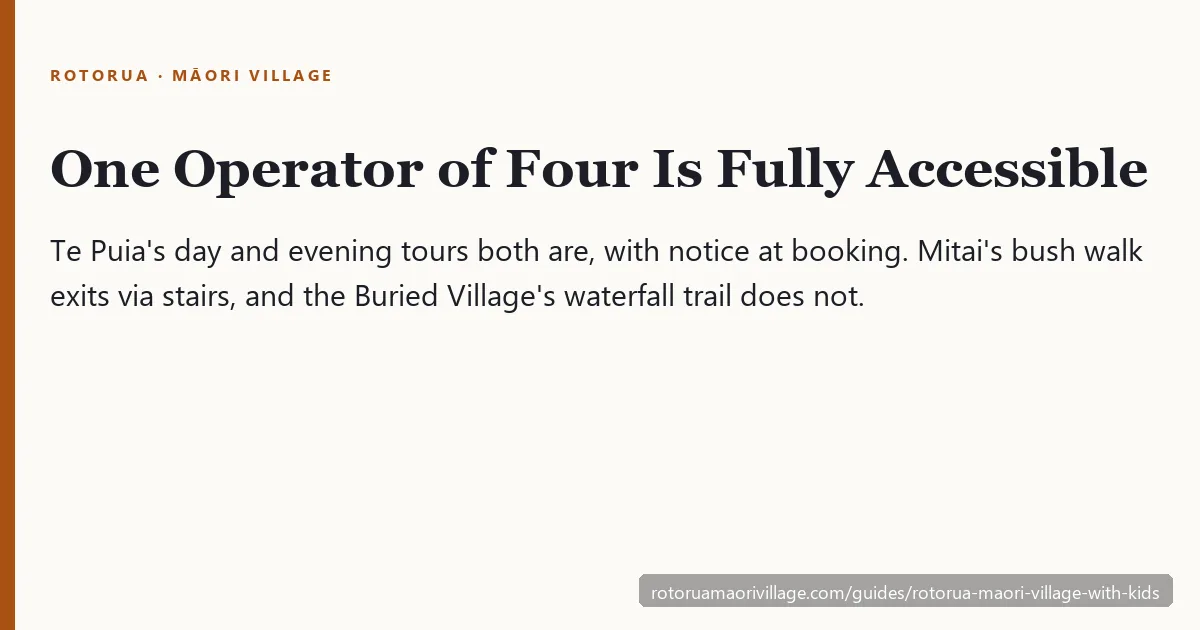
All nine experiences on this site describe themselves as suitable for all ages, and broadly they are. But “suitable for all ages” and “will work for your family on a Tuesday evening” are different claims, and the same applies to access and dietary needs. The single most accommodating operator on all three counts is Te Puia — wheelchair accessible with notice, vegetarian and gluten-free options at dinner, and infants under four admitted free. Here is where each of the others actually stands.
Check Availability
With young children
Length is the real constraint. The daytime options are short: the Whakarewarewa performance is 30 minutes, the village tour is an hour, Te Puia’s Te Rā is 90 minutes. The evenings run 2.75 to 4 hours, and Te Puia’s combo at four hours is a long sit for anyone under about eight.
Te Puia does not admit unaccompanied minors and prohibits smoking indoors, bare feet and see-through clothing on site. Infants under four enter free.
Mitai’s glow-worm walk is unlit. The bush trail at the end of the evening is genuinely dark, which small children either love or do not. Keep them close, and no flash — it wrecks the display for the whole group.
The Buried Village is the surprise family win. It runs a clue-based scavenger hunt through the museum and grounds, the trail is outdoors and open-ended, and at $15 it is the cheapest way to spend a couple of hours. Several reviewers specifically flag it as the activity that worked with kids.
The living village is the most demanding on behaviour, not because of the walking but because it is residential. Children need to stay on the paths, away from fences, and away from the boiling pools — the water is genuinely dangerous. It is a good experience for children old enough to be told that once and remember it.
Wheelchair access and mobility
| Experience | Access |
|---|---|
| Te Puia Te Rā | ✓ Wheelchair accessible — advise at booking |
| Te Puia Te Pō | ✓ Wheelchair accessible — advise at booking |
| Buried Village | ✓ Museum and main grounds · ✗ waterfall trail |
| Whakarewarewa performance | Seated and indoors |
| Whakarewarewa village tour | Uneven, occasionally steep paths — contact the operator |
| Mitai | Limited — the bush walk exits via stairs |
| Te Pā Tū | Forest site — contact the operator before booking |
Te Puia is the clear answer if access is essential, and the operator asks to be told at the time of booking so assistance can be arranged. The part most likely to need it is the walk down to the geyser terrace.
Mitai’s limitation is specific and late in the evening. The performance, the meal and the waka are all reachable; it is the forest bush walk at the end, which exits via stairs, that is the problem. That is worth weighing rather than ruling the whole evening out.
The Buried Village splits cleanly. Museum and main grounds are fine; the descent to Te Wairoa Falls involves a steep drop and a stair climb back, and is not.
Dietary requirements
Four of these experiences include a meal, and they differ more than you would expect.
Te Puia — vegetarian and gluten-free options are available at both the Te Pō dinner and the combo. Advise requirements when booking.
Te Pā Tū — gluten-free and vegetarian can generally be catered for, but the kitchen is not coeliac-approved, and the operator states plainly that not every dietary need can be met. If you are coeliac rather than gluten-avoiding, this matters.
Mitai — some requests can be met if flagged at booking, but the kitchen is built around hāngī and cannot provide vegan meals. The operator says so on its own listing. This is the clearest disqualifier on the site.
Whakarewarewa — no meal beyond the corn on the cob steamed in a geothermal pool, so dietary requirements are essentially moot.
In every case, flag the requirement at the time of booking, not on arrival. None of these kitchens can improvise on the night.
Practical notes for families
- Closed shoes for everyone, adults and children. The village paths are warm and uneven, and the thermal ground is not a place for sandals.
- The sulphur smell bothers some children for the first twenty minutes and then stops registering.
- Free cancellation up to 24 hours on all nine, which is the useful hedge when travelling with small children.
- Free on-site parking at Mitai and Te Puia. Te Pā Tū includes hotel pickup and drop-off in the ticket price, which is the easiest option if you are without a car.
- Whakarewarewa runs rain or shine — pack for it rather than planning to rebook.
Frequently asked questions
Which Rotorua Māori village is best with young children?
The Buried Village of Te Wairoa for open-ended outdoor time and its scavenger hunt, or the 30-minute Whakarewarewa performance if attention spans are short. Among the evenings, Mitai at three hours is more manageable than Te Puia’s four-hour combo.
Which Rotorua Māori experience is wheelchair accessible?
Te Puia — both the Te Rā day tour and the Te Pō evening are wheelchair accessible if you advise the operator when booking. The Buried Village’s museum and main grounds are accessible, though its waterfall trail is not.
Can I get a vegan meal at a Rotorua Māori village?
Not at Mitai, which states it cannot cater for vegan diets. Te Puia and Te Pā Tū handle vegetarian and gluten-free with notice; for a strictly vegan meal, plan to eat before or after rather than relying on the venue.
Are infants free?
At Te Puia, infants under four enter free. Other operators price children separately — the age bands show on each tour’s booking page.
Is the geothermal ground safe for children?
On the marked paths, yes. Off them, no — the pools are boiling and some crust is thin, which is why the fencing exists. Whakarewarewa suits children old enough to be told that once and stick to it.
Ready to book? See Te Puia’s Te Pō evening →
Related reading:
See the Village That People Still Live In
Whakarewarewa's guided tour is led by descendants of the families who have guided visitors here for six generations — through streets where the cooking is still done in the ground. Free cancellation up to 24 hours before.
Check Dates & Prices